Developing a reliable electronic product requires a structured electronics product development process that integrates hardware design, firmware engineering, PCB development, and validation. Whether you’re building an industrial controller, IoT device, or custom embedded system, following defined development stages reduces risk, controls cost, and ensures product success.
Below are the key stages followed by professional electronics product development companies.
1. Requirement Analysis
Every successful electronics product begins with clear and complete requirements.
This stage defines:
- Functional behavior of the system
- Performance targets (speed, accuracy, power usage)
- Operating environment (temperature, vibration, humidity)
- Compliance and safety requirements

Poor requirement analysis is one of the main causes of redesigns and delays in embedded product development.
2. System Architecture Planning & Feasibility Check
Before detailed design, engineers create a high-level system architecture.
This includes:
- Selection of microcontroller or processor
- Communication interfaces (CAN, Ethernet, SPI, I2C, UART)
- Power architecture
- Memory requirements
- Feasibility validation of design approach

A feasibility check ensures the concept is technically achievable within cost and timeline constraints.
3. Hardware Design
Hardware design is the stage where the electronic system moves from architecture planning to physical realization. It includes circuit engineering, component selection, and PCB development required to build a reliable embedded system.
This stage typically covers:
3.1. Circuit & Schematic Design
Engineers create detailed schematics based on system architecture, defining how components connect and interact.
- Microcontroller and processor circuitry
- Power supply and regulation circuits
- Signal conditioning and protection circuits
- Interface circuits for sensors and communication modules

3.2. Component Selection
Choosing the right components affects performance, cost, and availability.
- Microcontrollers and processors
- Memory components
- Communication modules
- Sensors and analog components
3.3. PCB Design & Layout
PCB design converts schematics into a manufacturable board.
Key considerations:
- Layer stack-up planning
- Component placement for thermal and signal performance
- High-speed routing and signal integrity
- EMI/EMC control
- Design rule checks (DRC)

A well-designed PCB ensures reliability and reduces hardware failures.
3.4. Thermal & Mechanical Considerations
Hardware engineers ensure the product survives real-world conditions.
- Heat dissipation planning
- Mechanical constraints
- Connector placement
- Enclosure compatibility
3.5. Hardware Review & Validation
Before prototyping, design reviews verify the hardware.
- Schematic review
- PCB layout verification
- Electrical rule checks
4. Prototype Development & Bring-up
Once the PCB is fabricated, a prototype is built for validation.
This stage involves:
- PCB assembly
- Board bring-up
- Hardware debugging
- Power-up sequence verification

Prototype bring-up identifies design errors early before production.
5. Firmware Design
Firmware development makes the hardware functional.
Tasks include:
- Peripheral driver development
- Communication stack implementation
- Real-time task handling
- Memory and performance optimization
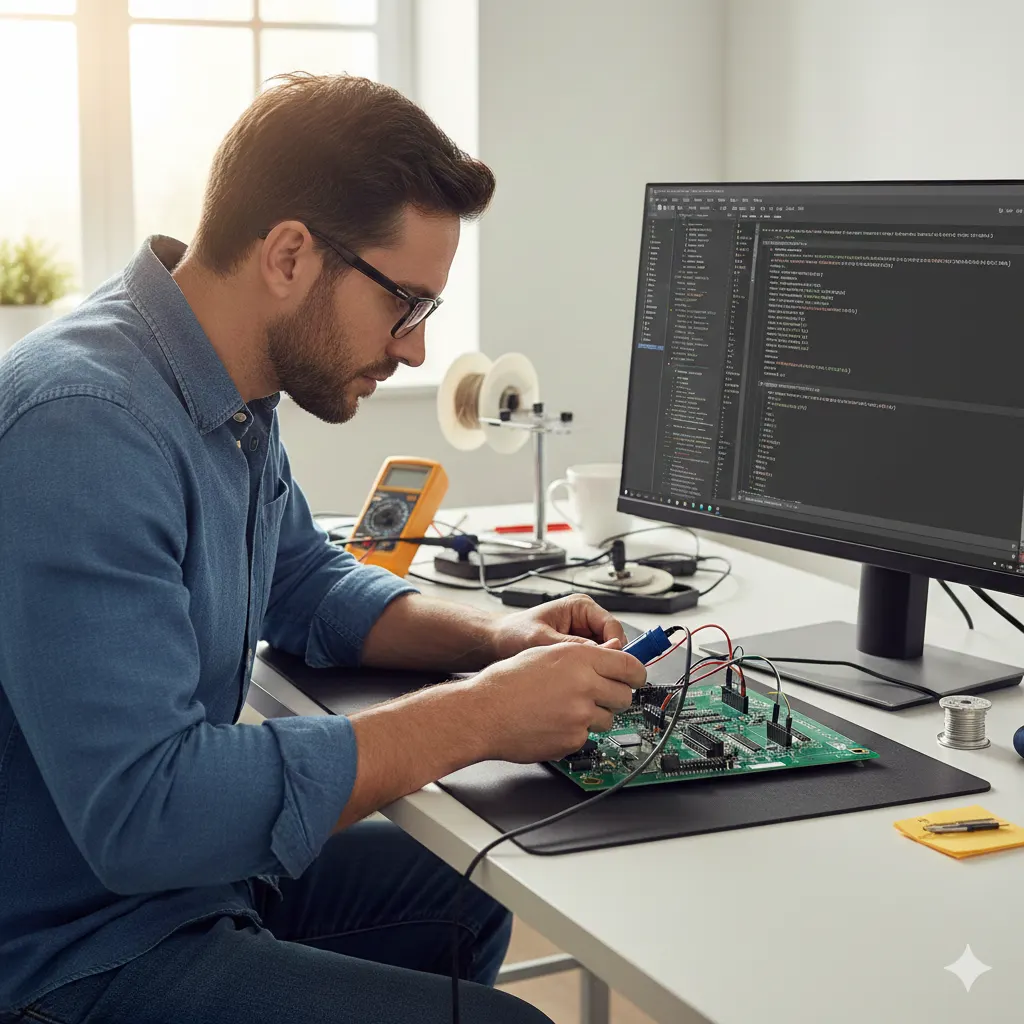
Stable firmware is critical for embedded system reliability.
6. Testing & Validation
Professional electronics product development requires extensive testing.
Common tests include:
- Functional testing
- Stress testing
- Environmental testing
- System performance validation
Testing ensures the product works reliably in real-world conditions.
7. Production Preparation
Before mass production, design adjustments are made.
This includes:
- BOM optimization
- Design for manufacturability
- PCB panelization
- Manufacturing documentation
Proper production preparation avoids factory issues.
8. Post-Production Support
Product development continues after launch.
Support may include:
- Firmware updates
- Hardware revisions
- Failure analysis
- Performance improvements
This ensures long-term product stability.
Looking for Electronics Product Development Support?
Blackfox Embedded Solutions provides end-to-end embedded hardware design, PCB engineering, firmware development, and product validation for industrial and product companies.
Frequently Asked Questions
How long does electronics product development take?
The timeline for electronics product development depends on product complexity, hardware design requirements, PCB iterations, firmware features, and testing stages. Development can range from a few months for simpler systems to longer cycles for advanced industrial or IoT products.
Do you provide electronics product development services in Coimbatore and Chennai?
Yes, we work with startups, manufacturers, and industrial companies in Coimbatore and Chennai, providing end-to-end electronics product development, including hardware design, PCB layout, firmware engineering, and system validation.
Do you work with companies across India and globally?
Yes, we support clients across India and international markets through structured remote collaboration, engineering documentation, and validation processes for embedded hardware and electronics product development projects.
Which industries use electronics product development services?
Electronics product development is widely used in industrial automation, manufacturing systems, IoT devices, agriculture technology, automotive electronics, and smart systems.
Do you provide production support after product design?
Yes, we support the transition from design to production. This includes manufacturing coordination, PCB optimization, design for manufacturability, and production assistance through our EMS (Electronics Manufacturing Services) Company.
Do you provide on-site support for product testing?
Yes, on-site support can be provided when required for product testing, validation, system integration, and troubleshooting during deployment or field trials.
How do you charge for electronics product development projects?
Projects are typically executed under a Time & Material (T&M) model. An initial proposal is provided with estimated effort based on project scope. Final billing is based on actual engineering hours utilized during development. Refer this video for more details https://youtu.be/MHz7R9eW6e4.